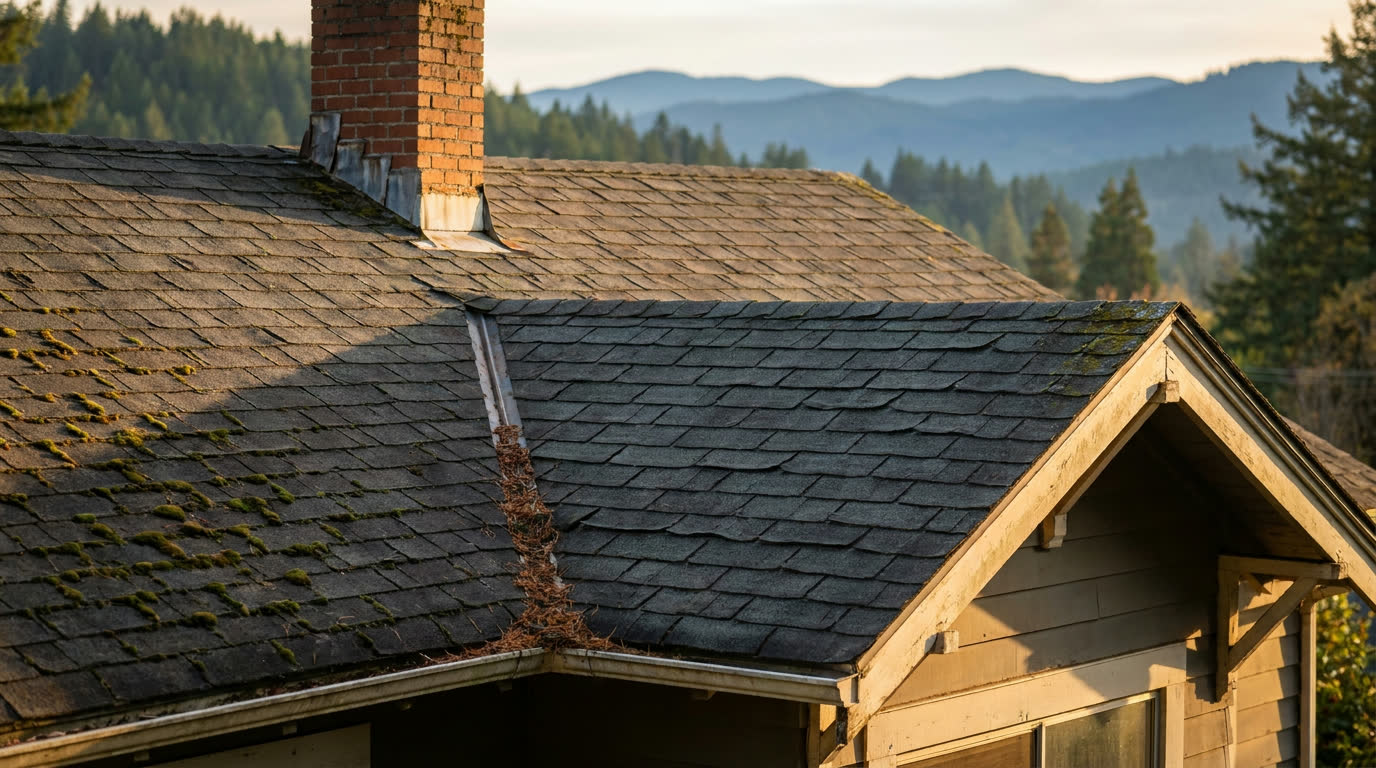
It's one of the most common calls we get at Custom Design LLC: "I think my roof might be bad, but I'm not sure." And honestly, that uncertainty makes sense. Most homeowners don't get on their roof — and shouldn't — so the first real warning they get is often a stain on the ceiling or a shingle in the yard after a windstorm.
Here's the good news: your roof usually tells you it's failing long before it actually fails. You just have to know what to look for. As a licensed general contractor and roofing company serving Myrtle Creek, Winston, Canyonville, Riddle, and the greater Douglas County area (CCB# 218862), we've inspected a lot of roofs in Southern Oregon conditions. This guide covers the signs we look for, when a repair is enough, and when replacement is the smarter investment.
01.Start With the Age of Your Roof
Before you look at a single shingle, answer one question: how old is the roof?
Most homes in Southern Oregon have architectural asphalt shingle roofs, which typically last 20 to 30 years. Three-tab shingles, common on older homes, wear out faster — often closer to 15 to 20 years. If your roof is pushing past those ranges, even a roof that "looks fine" from the driveway is living on borrowed time.
If you don't know the age, check your closing documents, ask the previous owner, or look for a permit record. If none of that works, a professional inspection can usually estimate age within a few years based on wear patterns.
Age alone doesn't mean automatic replacement. But it changes the math. Putting an expensive repair into a 25-year-old roof is often throwing good money after bad.
02.Signs You Can Spot From the Ground
You don't need to climb a ladder to catch most early warning signs. Walk around your house on a clear day and look for these:
- Curling or cupping shingles. Edges that turn up or centers that lift mean the shingles have lost their flexibility and are near the end of their life.
- Missing shingles or exposed spots. One or two after a windstorm can be repaired. Widespread loss usually means the adhesive seal across the whole roof has failed.
- Dark streaks or uneven color. Streaking is often algae, which is cosmetic — but large dull or dark patches can mean granule loss, which is not.
- Sagging rooflines. A dip or wave in the ridge or roof plane is a structural red flag. That's not a shingle problem; that's a decking or framing problem, and it needs attention now.
- Granules in your gutters. When you clean your gutters, look for what resembles coarse black sand. Heavy granule accumulation means your shingles are shedding their protective layer.
- Daylight in the attic. If you can get into your attic safely, turn off the lights on a sunny day. Any pinpoints of light coming through the roof deck mean water can get through too.
03.What Southern Oregon Weather Does to a Roof
Roofs here don't age the same way they do in Phoenix or Denver. Douglas County gives your roof a specific set of challenges, and knowing them helps you know where to look.
Moss and Constant Moisture
Our long, wet winters are ideal for moss — especially on north-facing slopes and roofs shaded by trees. Moss isn't just ugly. It holds moisture against the shingles, lifts shingle edges as it grows, and accelerates rot underneath. A light dusting can be treated. Thick, established moss that's been there for years has often already done damage you can't see from the ground.
Debris From Surrounding Trees
Fir needles and leaf litter pile up in valleys and gutters, trapping water where the roof is most vulnerable. Valleys are one of the most common leak points we find, and debris buildup is frequently the reason. If your home is surrounded by mature trees, your roof needs more frequent attention than the same roof in an open field.
The Wet-Dry Cycle
Southern Oregon swings from months of saturation to hot, dry summers. That expansion and contraction cycle is hard on shingles, flashing, and sealants. It's a big part of why flashing failures around chimneys, skylights, and vent pipes are such a common source of leaks here — the metal and the sealant age at different rates than the shingles around them.
04.Repair or Replace? How We Actually Decide
Not every problem roof needs a full replacement, and any contractor who jumps straight to "tear it all off" without walking you through the reasoning deserves a second opinion. This is the same honest, whole-structure approach we take to vetting any roofing contractor. Here's the framework we use.
When a Repair Makes Sense
A repair is usually the right call when the damage is isolated and the roof has meaningful life left. Typical repair scenarios include:
- A handful of shingles blown off in a windstorm on an otherwise sound roof
- A flashing failure around a chimney, skylight, or pipe boot
- A single leak traced to one identifiable point
- Localized damage from a fallen branch
If your roof is under roughly 15 years old and the rest of the field looks healthy, a targeted repair typically buys you years of service at a fraction of replacement cost.
When Replacement Is the Smarter Investment
Replacement moves to the top of the list when the problems are systemic rather than isolated:
- The roof is at or past its expected lifespan
- Shingles are curling, cracking, or shedding granules across large areas — not just one spot
- You're seeing multiple leaks, or leaks that keep coming back after repairs
- There's soft or spongy decking underfoot, which points to rot below the shingles
- You've already got two layers of shingles (Oregon code and good practice both say it's time to tear off, not layer again)
There's also a practical tipping point: when repair costs start stacking up year after year, you're paying maintenance prices for a roof that's failing anyway. At some point, that money is better spent on a new roof with a warranty behind it.
The most expensive roof replacement is the one you put off too long.
05.The Cost of Waiting
A worn roof that hasn't leaked yet is a roofing project. A worn roof that has been leaking for two winters is a roofing project plus rotted decking, plus wet insulation, plus stained drywall, and sometimes plus mold remediation. In our climate, water damage doesn't wait politely — one wet season is enough to turn a shingle problem into a structural one.
There's an insurance angle too. Insurers increasingly scrutinize roof age and condition, and damage resulting from long-term neglect is often not covered the way sudden storm damage is. Staying ahead of the problem protects both your house and your coverage.
06.What to Expect From a Professional Roof Inspection
If any of the signs above sound familiar, the next step is simple: get eyes on the roof. A thorough inspection should cover the shingle field, flashing at every penetration, valleys, gutters, ventilation, and — where accessible — the underside of the roof deck from the attic. You should come away with a clear picture of the roof's condition, an honest read on remaining life, and a straight answer on whether repair or replacement makes sense for your situation.
As a licensed general contractor as well as a roofing company, we look at your roof in the context of the whole structure — decking, ventilation, framing — not just the shingles on top. That matters, because a roof problem caught at the shingle stage is a very different project than one caught at the framing stage. It's also why hiring a roofer without a general contractor can leave you holding the risk when the job turns out to be more than a shingle swap.
Serving Myrtle Creek and South Douglas County
Custom Design LLC (CCB# 218862) provides roofing and general contracting services throughout Myrtle Creek, Winston, Canyonville, Riddle, Tri-City, and the surrounding Southern Oregon area. If you're not sure whether your roof needs a repair or a replacement, reach out — we'll give you an honest assessment and a clear path forward, whichever direction that turns out to be.